Container Freight Rates And The Main Rate Indices
| Rate type | All-in, base freight, or surcharge structure |
|---|---|
| Rate basis | Per container (e.g., TEU, FEU) or per shipment |
| Validity period | Fixed date range or contingent on sailing schedule |
| Applicable trade lane | Origin port(s) to destination port(s) range |
Origin and history
Container freight rates emerged as a standardized pricing mechanism in the mid-20th century alongside the commercialization of containerized shipping. The practice of systematically pricing container transport developed primarily in the United States and Europe during the 1960s and 1970s. This period saw the formation of shipping conferences, which were groups of carriers that collectively set rates on major trade routes. The need for transparent benchmarking led to the creation of the first main rate indices in the late 1980s and early 1990s. These indices were developed by maritime research firms and financial information providers to track spot market fluctuations outside of long-term contracts. The evolution of these rates and indices is directly tied to the globalization of manufacturing and the corresponding growth in seaborne trade.
What it is for
Container freight rates serve as the price for transporting a standardized container from one port to another, encompassing the carrier's costs and profit. They are the fundamental financial variable in the contract of carriage between a shipper (or their freight forwarder) and a shipping line. The main rate indices exist to provide an objective, averaged measure of current spot market price levels on specific trade routes. These indices are used by shippers to benchmark negotiated contract rates against the volatile spot market. They are also utilized by carriers for internal pricing strategy and by financial institutions for hedging instruments like freight futures. Ultimately, the system of rates and indices brings a degree of transparency and comparability to a complex and fragmented global market.
Overview
A container freight rate is typically quoted as a total cost per container, often broken down into a base ocean freight rate plus numerous ancillary surcharges. Surcharges can include fuel adjustment factors (BAF), currency adjustment factors (CAF), terminal handling charges (THC), and peak season surcharges (PSS). The main rate indices, such as the Shanghai Containerized Freight Index (SCFI) or the Drewry World Container Index (WCI), aggregate data from multiple freight forwarders and carriers. These indices publish weekly composite figures for key routes, like Asia to Europe or Asia to North America West Coast. The rate itself is not a single universal price but varies drastically by trade lane, container size (e.g., 20ft or 40ft), service speed, and cargo type. This ecosystem of rates and indices forms the financial backbone of all containerized supply chains.
What to know
You should know that a quoted freight rate is often only a starting point, as surcharges can significantly increase the final landed cost. It is critical to understand the difference between long-term contract rates, which provide price stability, and volatile spot market rates, which reflect immediate supply and demand. The main indices primarily track the spot market and are leading indicators of overall market health but may not reflect your specific contractual rate. Rate levels are driven by fundamental factors including vessel capacity, port congestion, fuel costs, and consumer demand for goods. Negotiating a rate requires clarity on which surcharges are included, the currency of payment, and the validity period of the quoted price. Furthermore, rates are highly cyclical, experiencing extreme peaks during periods of congestion and steep troughs during periods of overcapacity.
Common questions
A common question is why freight rates can change so rapidly, sometimes weekly, which is due to the spot market's sensitivity to immediate port delays and vessel space availability. Many ask how to use the main indices, which are best used as a market trend reference rather than an exact quote for a specific shipment. Shippers frequently question the legitimacy of numerous surcharges, which are generally accepted industry practices but should be scrutinized for applicability and calculation method. Another frequent inquiry concerns the difference between all-inclusive rates and rates that exclude surcharges, making it essential to confirm what "all-in" means in each quotation. Users often wonder who contributes data to the indices, which are typically supplied confidentially by a panel of large freight forwarders and non-vessel operating common carriers (NVOCCs). Finally, a recurring question is whether indices can predict future rates, which they cannot do with certainty but can signal strengthening or weakening market conditions.
Pros and cons
A primary pro is that a well-negotiated long-term contract rate provides cost certainty and space allocation, protecting a shipper from extreme spot market volatility. The con is that being locked into a contract can be disadvantageous if the spot market falls significantly below your contracted rate, causing you to overpay. The main rate indices provide market transparency, but a significant con is that they can oversimplify a complex landscape, as an average index figure may not reflect the rate for a specific port pair or service level. A common mistake is focusing solely on the base ocean rate while ignoring surcharges, which can lead to unexpected costs that erase perceived savings. Shippers who rely entirely on the spot market for all shipments often regret it during periods of acute capacity shortage, when rates skyrocket and space is unavailable. Conversely, carriers can regret offering long-term fixed rates during sudden upturns, missing out on higher spot market revenue.
Who it suits
Long-term contract rates suit large-volume shippers with predictable annual volumes who prioritize supply chain stability and guaranteed vessel space over absolute lowest cost. They are essential for importers and exporters who require reliable cost forecasting for their financial planning and product pricing. The main rate indices are particularly suited to logistics managers, procurement specialists, and market analysts who need a quick, standardized snapshot of market trends. Spot market rates suit opportunistic shippers with flexible shipping schedules, smaller volumes, or those who can absorb the risk of rate fluctuations and potential space shortages. Freight forwarders and NVOCCs use both contract rates and indices daily to price their services and advise their clients on market timing. Financial traders and institutions utilize the indices specifically for settling freight derivative contracts, which are used for hedging by some large shipping parties.
Latest Container Freight Rates And The Main Rate Indices news
Latest reporting

Global container shipping reliability falls to 29% in August
Schedule reliability for global container shipping dropped to 29% in August, with average delays rising to 5.1 days, according to analyst Xeneta.
SONAR Launches Custom Insights for Shipper Consortium
FreightWaves' SONAR platform launches SCI: Custom Insights, a new tool for its Shipper Consortium members to benchmark their freight data against...

Estes Invests $56 Million in Cross-Border Freight Network
Estes Express Lines is spending nearly $56 million to expand its cross-border and offshore freight capacity, targeting growth in Canada, Mexico...

Rail container delays rise at Los Angeles-Long Beach ports
Container dwell times for rail-bound cargo increased to 6.75 days in August at the Los Angeles-Long Beach port complex, while truck-bound cargo times

Truckload Volumes Fall 15% as Spot Rates Hold Strong
Truckload freight volumes dropped nearly 15% on September 9, but spot rates remained raise at $3.44 per mile, up 47% year-over-year.
Global container volumes hit record 17.3 million TEUs
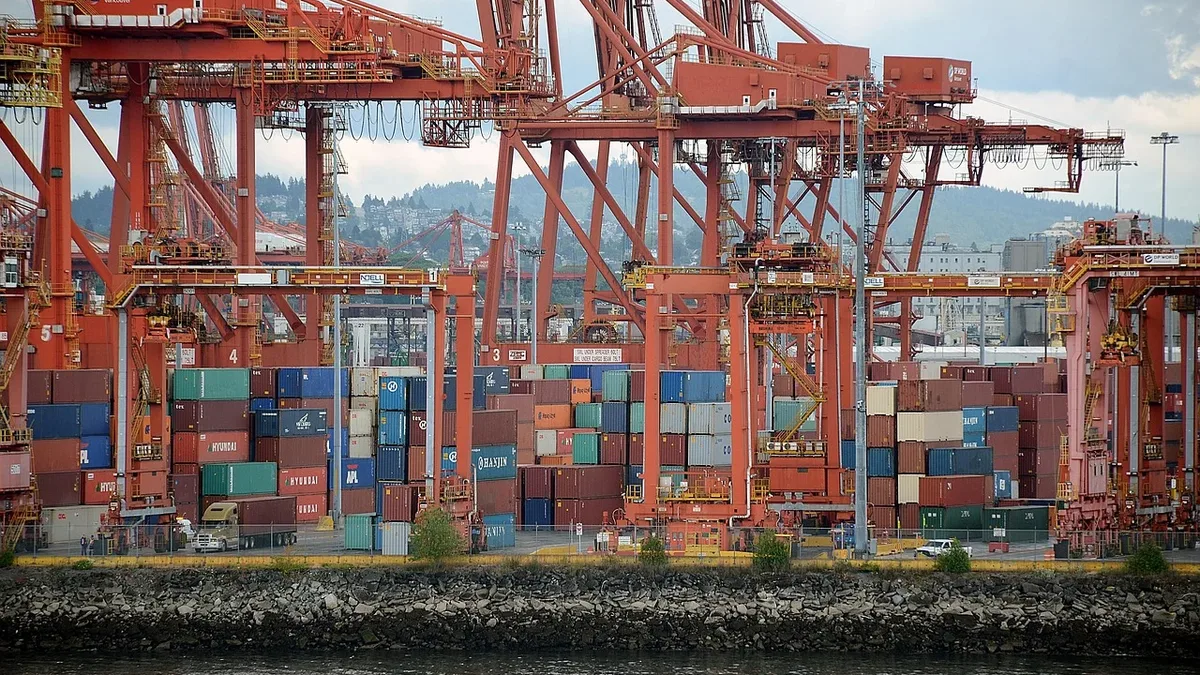
World container throughput reached a new monthly high of 17.3 million TEUs in July 2026, with year-to-date volumes up 5.1%.