Tesla Semi Targets European Deliveries by End-2027
Tesla's head of Semi, Dan Priestley, announced the company will begin European demonstrations in the first half of 2027, targeting customer deliveries by
Tesla will begin European demonstrations of its Semi electric truck in the first half of 2027 and is targeting customer deliveries by the end of that year. Dan Priestley, head of Semi at Tesla, announced the timeline during a keynote at the IAA Transportation 2026 event in Hannover, Germany.
Priestley said the company is currently working to line up highly interested customers for the demonstration program. The first European trucks will be built at Tesla's plant outside Reno, Nevada.
Homologation and European Specifications
The European version of the Semi is rated for 550 kilometers of usable range, with an energy consumption of 1 kilowatt-hour per kilometer. These figures are measured at a gross combination weight of 40 metric tons. The truck's curb weight is 9,100 kilograms.
It accepts an 800-kilowatt charge, which Priestley said recovers more than 60% of the range in 30 minutes. The tractor is designed to operate at weights up to 44 metric tons for drayage and container work.
Priestley emphasized that the core hardware is identical to the North American standard-range model. "All the major technology pieces, the frame rails, the chassis, battery pack, drive axles, all of them are the same," he said. The different range rating is due to a different European test cycle, not a larger battery.
Changes for the European market are primarily for homologation. These include European lighting requirements, a tachograph, a modified trailer interface, and splash guards. European regulations also permit camera-monitor systems instead of mirrors, a feature not yet allowed on U.S. Models.
The cab features a forward center seating position behind wraparound glass, which Priestley said is critical for urban maneuverability. Independent front suspension allows the three-axle truck to handle like a two-axle vehicle. "It fits the turning circle quite nicely, and we're confident it'll work in the variety of European environments," he stated.
Charging Infrastructure and Pricing
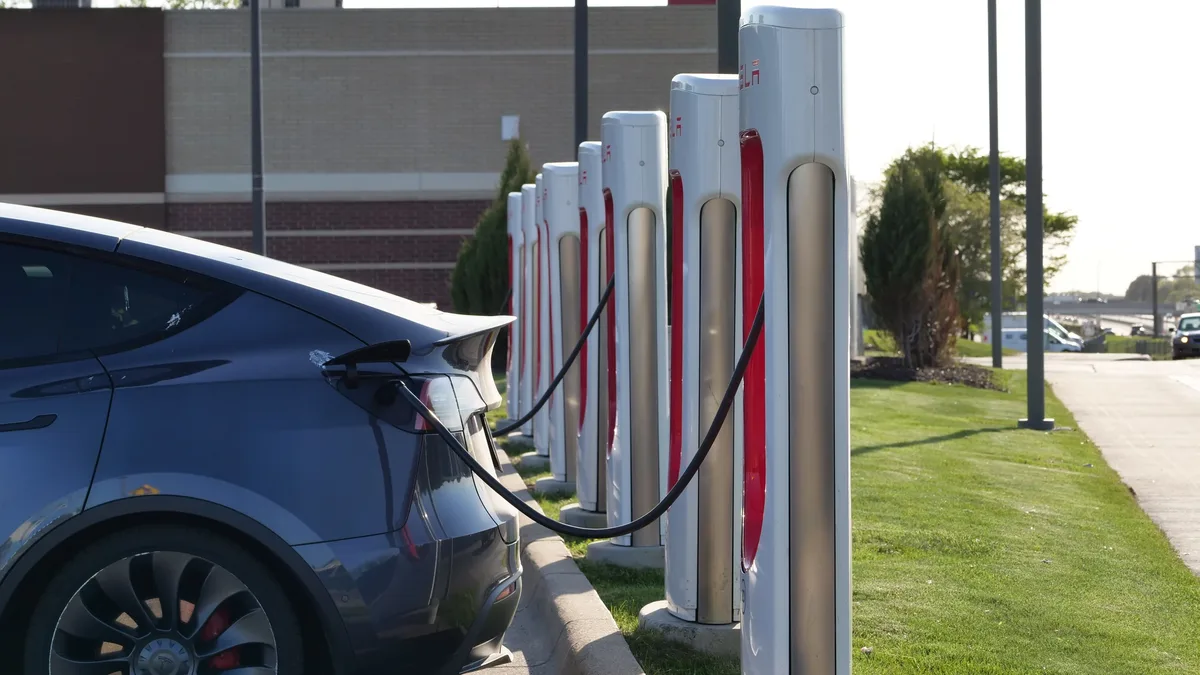
Tesla plans to open its European Megacharger network next year with more than 100 stalls, each capable of 1.2 megawatts. At least 22 European charging locations are planned.
For depot charging, Tesla offers the Basecharger, a 120-kilowatt unit priced at 17,000 euros. Three units can be daisy-chained and split to provide 40 kilowatts each. The chargers are currently on sale, though a firm date for European truck sales has not been set.
Fleet Performance and Service Plans
The global Semi fleet has accumulated over 28 million kilometers, Priestley reported. Customers have driven 19 million of those kilometers on regional delivery and linehaul duty cycles. This total includes 400,000 kilometers driven by a demonstration fleet lent to prospects for testing. He put the fleet's uptime this year at 98%.
Tesla operates dedicated Semi service centers in North America and plans to establish the same structure in Europe. Priestley tied this capability to more than a decade of training high-voltage technicians. The demonstration program also allows potential customers to evaluate the service network.
Path to Autonomy and Production Capacity
When asked about autonomy, Priestley said Tesla is currently focused on driver assistance and safety features for the Semi. The company is using human-driven trucks to gather training data for eventual full autonomy, but he set no date for its achievement. He described the work as creating a smooth, confident experience for the driver by weeding out false alerts.
The Nevada plant has a design capacity of 1,000 trucks per week, or 50,000 per year, and is already building customer vehicles. Priestley said this capacity is why establishing a European factory is not currently a priority. We're not worried about that at this time, he said. We've got ample capacity to support our initial wave, but whenever it makes sense, we'll look at various localization efforts. He confirmed the Nevada facility would open for customer visits the following week, coinciding with a September 24 event in Sparks.