Cross Border E Commerce Customs Regimes
| Tariff line | Provided in the agreement |
|---|---|
| Agreement type | International trade agreement or national legislation |
| Jurisdiction | Country or customs union implementing the regime |
| Primary intent | To facilitate and regulate low-value cross-border e-commerce shipments |
| Goods coverage | Typically low-value, non-restricted, non-dangerous goods |
| Duty treatment | Often duty-free below a specific de minimis value threshold |
| Data requirement | Requires advance electronic data (e.g., CN22/23 customs declaration) |
Origin and history
Cross Border E Commerce Customs Regimes are administrative frameworks developed by national governments to manage the flow of low-value goods purchased online from foreign sellers. Their origin is not tied to a single country but emerged globally in response to the rapid growth of international e-commerce in the late 1990s and early 2000s. Initially, many countries simply applied their standard customs procedures to all imports, regardless of value. This approach became unsustainable as the volume of small parcels exploded, creating administrative bottlenecks. Countries began to design specific regimes to balance efficient customs processing with the need for tax collection and regulatory control. The European Union, United States, and China were among the early adopters in formalizing distinct procedures for low-value e-commerce shipments, with many other nations following suit throughout the 2010s.
What it is for
These regimes exist to facilitate the clearance of a high volume of low-value, individually-addressed parcels resulting from online consumer purchases. Their primary purpose is to reduce administrative burdens for both customs authorities and logistics carriers that would be overwhelmed by applying full, formal entry procedures to every small package. A key function is to enable the collection of applicable taxes, such as value-added tax (V.S.A.T.) or goods and services tax (G.S.T.), on imports that would otherwise evade taxation due to high collection costs. They also serve as a regulatory channel to enforce prohibitions and restrictions on certain goods, like counterfeit products or unsafe materials, even at low values. Furthermore, they aim to level the playing field between domestic retailers, who collect sales tax at point of sale, and foreign sellers. Finally, they provide a simplified data framework for customs authorities to perform risk assessment and targeted inspections on e-commerce traffic.
Overview
A Cross Border E Commerce Customs Regime typically establishes a simplified declaration process for goods below a specific monetary threshold, known as a de minimis value. Shipments valued under this threshold qualify for streamlined clearance, often involving a consolidated electronic data submission by the carrier rather than individual, detailed customs declarations for each parcel. The regime mandates that the applicable domestic consumption taxes be assessed and collected, either from the buyer at the point of delivery, from the platform, or from the carrier. It defines the responsibilities of the various parties in the supply chain, including the online marketplace, the seller, the logistics provider, and the purchaser. These regimes are distinct from traditional bulk commercial import procedures and are frequently updated to address new business models, such as direct-to-consumer shipping from overseas fulfillment centers. The specific rules, including the de minimis value, tax rates, and compliance requirements, vary significantly from one country to another.
What to know
The de minimis threshold is a critical component, but it is not a tax-free allowance; it is merely the value under which a simplified procedure applies, and taxes are almost always still due. Sellers and platforms are increasingly being held directly responsible for collecting and remitting taxes at the point of sale, a shift known as "vendor collection" model. Incorrect or missing data on the customs declaration, such as an inaccurate Harmonized System (H.S.) code or value, is the most common cause of clearance delays and can lead to penalties. These regimes are dynamic and subject to frequent change as governments seek to close tax gaps and improve enforcement, meaning compliance requirements from six months ago may be outdated. Understanding the difference between duty (which may be waived under a low threshold) and domestic taxes (which are virtually never waived) is essential for accurate cost calculation. It is also vital to know that prohibited or restricted goods are not automatically admissible simply because a shipment qualifies for the e-commerce regime.
Common questions
What is the difference between duty and tax in these regimes? Duty is a tariff on the imported good itself, often waived for low-value shipments, while tax is a domestic consumption charge like V.S.A.T. that is almost always payable. Who is legally responsible for paying the import taxes? Liability can fall on the purchaser, the seller, or the platform depending on the country's specific regulations and any implemented vendor collection schemes. Does using a low-value regime guarantee faster clearance? While designed for speed, parcels are still subject to risk-based controls and can be held for inspection if data is suspect or the goods are flagged. How is the value of a shipment calculated for customs? It is typically the transaction value (price paid) plus insurance and freight costs up to the point of import. Are all goods eligible for the simplified e-commerce procedure? No, goods subject to quotas, anti-dumping duties, or strict licensing controls usually require a full formal entry regardless of value. What happens if a seller deliberately undervalues a shipment? This is customs fraud and can result in seizure of goods, fines for the involved parties, and potential blacklisting.
Pros and cons
A primary pro is the significant reduction in administrative cost and delay for both authorities and businesses, enabling the practical functioning of global online retail. For consumers, it can simplify the process of receiving goods and make costs more predictable when taxes are collected upfront by the seller. A major con is the complexity and lack of harmonization between different national regimes, creating a compliance maze for sellers shipping worldwide. Common mistakes include sellers assuming their home country's rules apply globally or failing to update their systems after a destination country changes its threshold or tax rules. Many businesses regret choosing to ignore these regimes, as unexpected tax assessments and clearance delays handed to their customers damage brand reputation and lead to cart abandonment. The system can also be exploited by bad actors who ship illicit goods in small parcels, believing they will attract less scrutiny, though authorities are increasing targeted enforcement.
Who it suits
These regimes are essential for any business engaged in direct-to-consumer international e-commerce, including small and medium-sized enterprises selling via their own websites or platforms like Shopify. They suit large online marketplaces and platforms that can integrate tax calculation and collection at checkout, thereby simplifying the experience for the end buyer. Logistics carriers and postal operators also rely on these frameworks to manage the high-volume, low-complexity segment of their international parcel flows. They are less suitable for businesses importing commercial samples, high-value goods, or products subject to strict regulatory controls, which typically must use standard customs procedures. Consumers benefit from these regimes when they function smoothly, as they enable access to a global marketplace, but they must be aware that they are ultimately liable for any unpaid taxes and duties if the seller does not collect them.
Latest Cross Border E Commerce Customs Regimes news
Latest reporting

Russia's WTO Challenge to EU Carbon Levy Triggers Panel
A WTO dispute panel will examine Russia's claims that the EU's carbon border adjustment mechanism and emissions trading scheme violate trade rules...
Estes Invests $56 Million in Cross-Border Freight Network
Estes Express Lines is spending nearly $56 million to expand its cross-border and offshore freight capacity, targeting growth in Canada, Mexico...

AI Hardware Demand Splits Asian Air Cargo Export Market
The Asian air cargo export market is entering peak season divided, with strong AI-related demand boosting transpacific volumes while new EU e-commerce
US Customs Scrutinizes Importer Records Years After Shipment
US Customs and Border Protection is reviewing import entries up to 314 days after cargo release, with importers responsible for records for five...
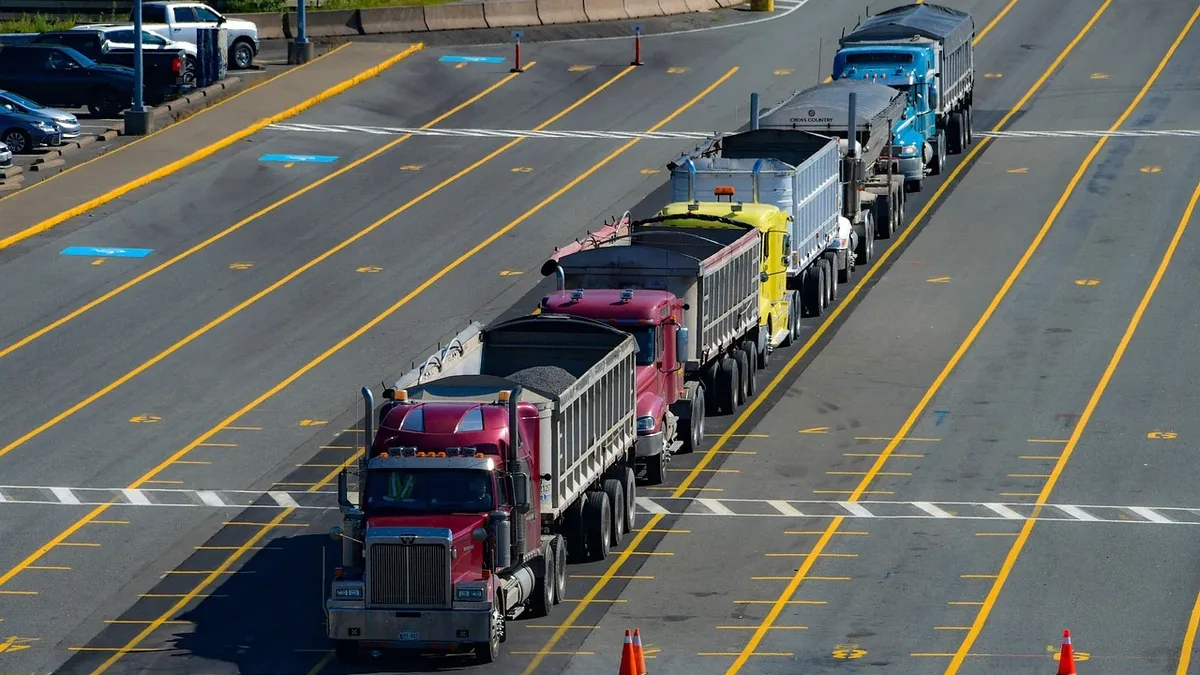
Mexican truckers block Calexico border over visa revocations
Mexican truck drivers blocked the Calexico East-Mexicali commercial border crossing Thursday, protesting the revocation of B-1 visas by U.S.