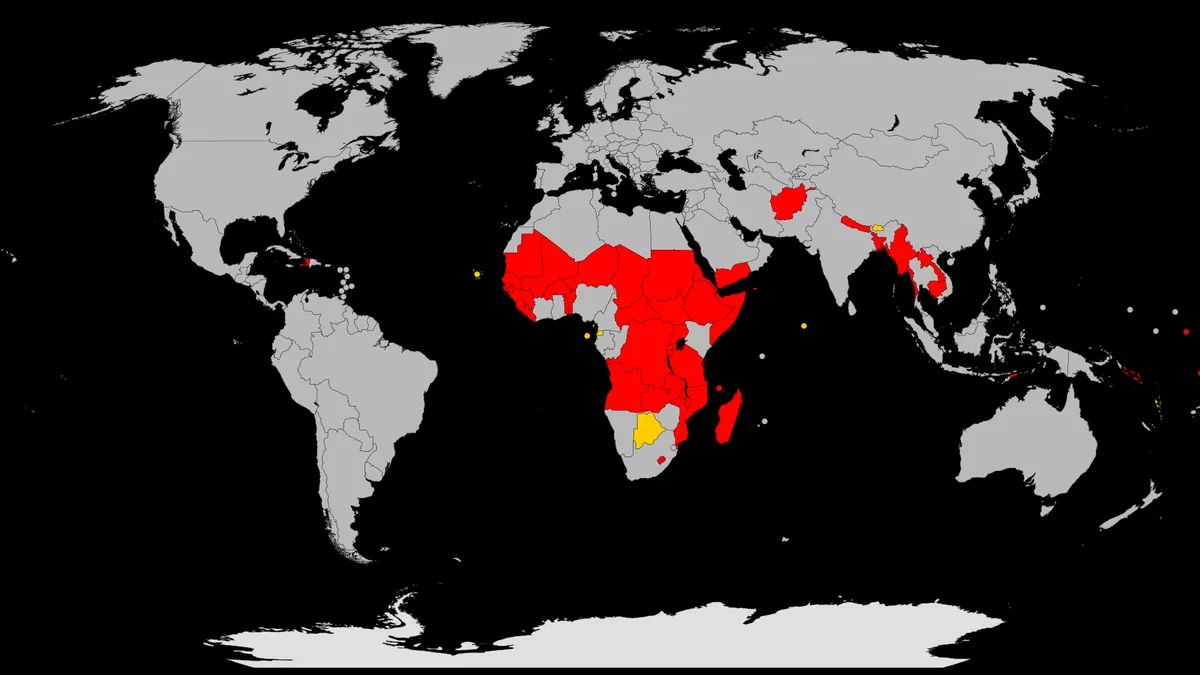
Gsp, Gsp+ And Everything But Arms Preferences
| Agreement type | Non-reciprocal trade preference scheme |
|---|---|
| Administered by | European Union |
| Beneficiary status | Granted to developing countries |
| Tariff treatment | Reduction or elimination of customs duties |
| Product coverage | All products except arms and ammunition |
| Conditionality | Linked to sustainable development and human rights principles |
| Preference level | Varies by country designation (Standard GSP, GSP+, EBA) |
Origin and history
The Generalized System of Preferences (GSP) originated as a concept within the United Nations Conference on Trade and Development (UNCTAD) in the late 1960s. It was formally adopted by the European Economic Community, the precursor to the European Union, in 1971, making the EU one of the first major economies to implement such a scheme. The core objective from its inception was to foster economic development in poorer countries by providing non-reciprocal, duty-free access to industrial markets. The "GSP+" enhanced arrangement was introduced by the EU in 2005, adding a special incentive scheme for sustainable development and good governance. The "Everything But Arms" (EBA) initiative, a sub-component of the GSP, was launched by the EU in 2001, representing its most comprehensive preferential regime. These frameworks are not static and are periodically revised, with the current EU GSP regulation applying from 2014 and set for review.
What it is for
The fundamental purpose of the EU's GSP framework is to support poverty reduction and promote sustainable development in vulnerable economies by facilitating their integration into the global trading system. By removing or reducing import duties, it aims to increase the export earnings of beneficiary countries, which is intended to support industrialization and economic diversification. The standard GSP scheme is designed for low and lower-middle income countries, helping them to strengthen their export sectors. The GSP+ arrangement specifically incentivizes the ratification and effective implementation of 27 core international conventions relating to human rights, labour rights, environmental protection, and good governance. The Everything But Arms scheme exclusively targets the Least Developed Countries (LDCs), as defined by the UN, offering them the most favourable terms. Ultimately, the entire architecture seeks to use trade as a tool for development, rather than purely commercial or reciprocal gain.
Overview
The EU's Generalized System of Preferences is a unilateral trade arrangement through which the EU provides preferential access to its market for imports from developing countries. It is structured as a three-tier system with varying levels of benefits and conditionality. The standard GSP removes customs duties on approximately 66% of all EU tariff lines for eligible countries, though sensitive product categories may have reduced duties rather than full removal. The GSP+ scheme grants full duty suspension on essentially the same tariff lines as the standard GSP, but requires adherence to strict conditionalities regarding international conventions. The Everything But Arms scheme provides duty-free, quota-free access for all products from LDCs, with the sole exception of arms and ammunition, which are excluded for obvious reasons. The preferences are not negotiated treaties but are autonomously granted and can be modified or withdrawn by the EU based on changes in a country's economic status or compliance with rules.
What to know
Eligibility for these schemes is not permanent and is subject to regular review by the European Commission, with countries potentially "graduating" from benefits if they achieve a higher income classification. The rules of origin are a critical and complex component, requiring that products be "wholly obtained" or "sufficiently worked or processed" within the beneficiary country to qualify for preferential rates. There is a system of temporary withdrawal for serious and systematic violations of the principles in the relevant conventions, particularly under GSP+, which has been invoked in the past. The "safeguard clause" allows the EU to reintroduce normal customs duties if imports from a GSP beneficiary cause or threaten to cause serious difficulties to EU producers. For traders, using these preferences requires providing a proof of origin, typically a certificate known as Form A or a statement on origin from an approved exporter. The list of beneficiary countries under each tier is published in the EU's Official Journal and can change, so exporters and importers must verify the current status for a specific origin.
Common questions
A frequent question is whether a product automatically receives the preferential rate upon import if it originates from a beneficiary country, and the answer is no, as the importer must actively claim it and provide valid proof of origin. Many ask what happens when a country graduates from Least Developed Country status, and in such a case, the country typically transitions from EBA to the standard GSP scheme for a limited period. Exporters often inquire about the difference between GSP and a Free Trade Agreement (FTA), with the key distinction being that GSP is non-reciprocal and unilateral, whereas an FTA involves mutual concessions. A common confusion arises around the product coverage of standard GSP versus GSP+, as they largely cover the same tariff lines, but GSP+ has stricter eligibility criteria beyond economic development. Importers regularly question how to correctly interpret and apply the specific rules of origin for their product, which requires consulting the detailed annexes of the GSP regulation. Businesses also ask about the stability of the preferences, given their unilateral nature, and while the regulation provides a multi-year framework, the benefit for a specific country can be suspended with notice.
Pros and cons
A primary advantage is the significant cost saving for importers and competitive price advantage for exporters from beneficiary countries, making their goods more attractive in the EU market. The GSP+ mechanism successfully uses trade incentives to promote tangible improvements in human rights and environmental standards in some beneficiary states. For Least Developed Countries, EBA provides a vital, predictable framework for export-led growth without the complexity of negotiating a full FTA. A major con is the administrative burden and cost of compliance with rules of origin, which can be prohibitive for small businesses and may deter them from using the scheme at all. The unilateral nature of the system is a double-edged sword, as the EU can modify terms or withdraw status, creating uncertainty for long-term investment in export industries in beneficiary countries. A common mistake is for exporters to assume eligibility based on a country's general status without checking the specific product's tariff line and rule of origin, leading to costly customs disputes and retroactive duty payments.
Who it suits
The standard GSP scheme best suits low and lower-middle income countries that have a nascent or developing export manufacturing sector and need a cost advantage to compete in the EU market. The GSP+ arrangement is tailored for vulnerable low and lower-middle income countries that are committed to, and capable of, implementing rigorous international standards on human rights, labour, environment, and governance. The Everything But Arms scheme is exclusively designed for and suits the world's Least Developed Countries, providing them with the broadest possible market access to support their economic development. From an importer perspective, these preferences suit EU businesses sourcing raw materials, intermediate goods, or finished products from these developing regions, where price sensitivity is high. The system does not suit more advanced developing economies, which are expected to graduate from benefits, or countries unwilling to adhere to the governance conditions of GSP+. It also may not suit exporters of very simple goods who find the cost of proving compliance with rules of origin exceeds the value of the tariff savings.