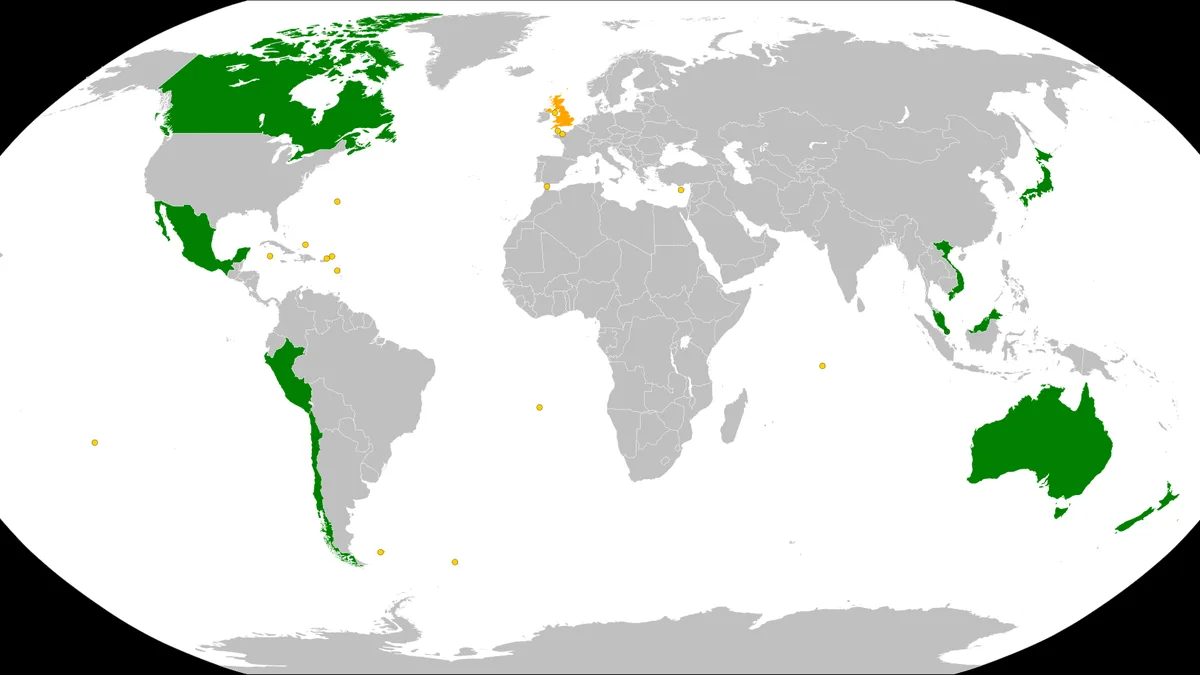
Cptpp
| Agreement | Comprehensive and Progressive Agreement for Trans-Pacific Partnership |
|---|---|
| Type | Preferential tariff line |
| Status | In force for ratifying members |
| Geographic scope | Asia-Pacific region |
| Member count | 11 countries |
| Purpose | Reduce or eliminate tariffs on goods trade |
| Administration | Rules of origin and certification required |
Origin and history
The Comprehensive and Progressive Agreement for Trans-Pacific Partnership (CPTPP) originated from the earlier Trans-Pacific Partnership (TPP) agreement. The TPP was negotiated throughout the early 2010s among twelve Pacific Rim nations, concluding in 2016. Following the withdrawal of the United States from the TPP in 2017, the remaining eleven nations renegotiated the agreement. The revised pact, now named the CPTPP, was signed in March 2018. The agreement entered into force for the first group of ratifying countries in December 2018. Its creation was driven by a collective intent to preserve the economic integration framework established by the original TPP negotiations.
What it is for
The CPTPP is a multilateral free trade agreement designed to reduce barriers to trade and investment among its member countries. Its primary purpose is to eliminate or significantly reduce tariffs on a wide range of goods and services traded between signatories. It establishes common rules on intellectual property, labor standards, environmental protections, and the conduct of state-owned enterprises to create a more level playing field. The agreement aims to facilitate supply chain integration across the Asia-Pacific region by harmonizing regulations and standards. It serves to promote economic growth and job creation within member economies through enhanced market access. Furthermore, it is intended to set a high-standard benchmark for regional trade agreements in the 21st century.
Overview
The CPTPP is a legally binding trade pact between eleven countries: Australia, Brunei Darussalam, Canada, Chile, Japan, Malaysia, Mexico, New Zealand, Peru, Singapore, and Vietnam. It incorporates most of the provisions from the original TPP, with a limited number of suspensions primarily related to intellectual property. The agreement covers thirty chapters addressing diverse areas such as trade in goods, rules of origin, customs procedures, sanitary measures, technical barriers to trade, and electronic commerce. A key feature is its comprehensive tariff elimination schedules, where members commit to phasing out duties on nearly all imports from other CPTPP parties. It also includes enforceable commitments on labor rights and environmental protection, which are subject to the agreement's dispute settlement mechanisms. The agreement is structured to allow for the future accession of new economies that can meet its high standards.
What to know
Businesses must understand that the CPTPP's benefits are not automatic and require compliance with specific rules of origin to claim preferential tariff treatment. Each product must meet the agreement's detailed origin criteria, often involving regional value content calculations or tariff classification changes, documented through a certification process. The agreement's text and its associated tariff schedules are complex legal documents that vary by member country and product category, necessitating careful consultation. While tariffs are reduced, non-tariff barriers are addressed through chapters on regulatory coherence, which aim to make technical standards more transparent and compatible. The agreement includes investor-state dispute settlement (ISDS) provisions, allowing investors to seek arbitration against host governments for alleged breaches of investment protections. It is crucial to monitor individual member countries' implementation schedules, as phase-out periods for certain sensitive products can extend over many years.
Common questions
A common question is whether the CPTPP is the same as the TPP, to which the answer is that it is a distinct agreement that incorporates most TPP provisions but with several suspended obligations. Many ask which tariffs are eliminated, and the answer is that nearly all tariffs on industrial and agricultural goods are eventually reduced to zero, though specific phase-out timelines depend on the product and the importing country. Users frequently inquire about rules of origin, needing to know that goods must be "originating" within the CPTPP region, often requiring substantial transformation or meeting specific product rules. Businesses question how to prove origin, which is typically done by the exporter completing a self-certification of origin, not by obtaining a government-issued certificate. Another frequent query concerns the agreement's stance on digital trade, which includes prohibitions on data localization requirements and on customs duties for electronic transmissions. People also ask about new members, and the process involves rigorous negotiations and a consensus decision by existing parties, with several economies having formally applied to join.
Pros and cons
A significant pro is the creation of a large, high-standard free trade area that can reduce costs for businesses through tariff elimination and more predictable regulations, particularly benefiting exporters and firms in integrated supply chains. The agreement's comprehensive coverage of modern trade issues, such as e-commerce and state-owned enterprises, addresses gaps left by older trade pacts. A notable con is the complexity and cost of compliance, especially for small and medium-sized enterprises that may lack the resources to navigate the intricate rules of origin and certification procedures. Some sectors within member countries, particularly agriculture and certain manufacturing industries, face increased competition from imports, which can lead to adjustment pressures and job losses. Critics argue that the suspended IP provisions, while making the pact more palatable for some members, undermine the coherence of the original agreement and its potential to set uniform standards. A common mistake is for businesses to assume automatic eligibility without verifying origin rules, leading to denied preferential treatment and unexpected duties at the border.
Who it suits
The CPTPP suits export-oriented businesses, particularly those with operations or supply chains spanning multiple member countries, as they can maximize benefits from tariff cuts and unified rules. It is advantageous for firms in sectors with high existing tariffs, such as agriculture, forestry, seafood, and manufactured goods like machinery and chemicals, where preferential market access provides a competitive edge. Investors seeking strong legal protections in member markets may find the agreement's investment chapter and ISDS mechanisms beneficial. The pact suits economies seeking to diversify their trade relationships and reduce dependence on any single market by integrating into a broader regional bloc. It is less suited to purely domestic-focused businesses or industries that are highly sensitive to import competition and lack the capacity to adapt quickly. The agreement also suits policymakers in economies aiming to use trade policy as a tool to drive domestic regulatory reform and attract foreign direct investment.