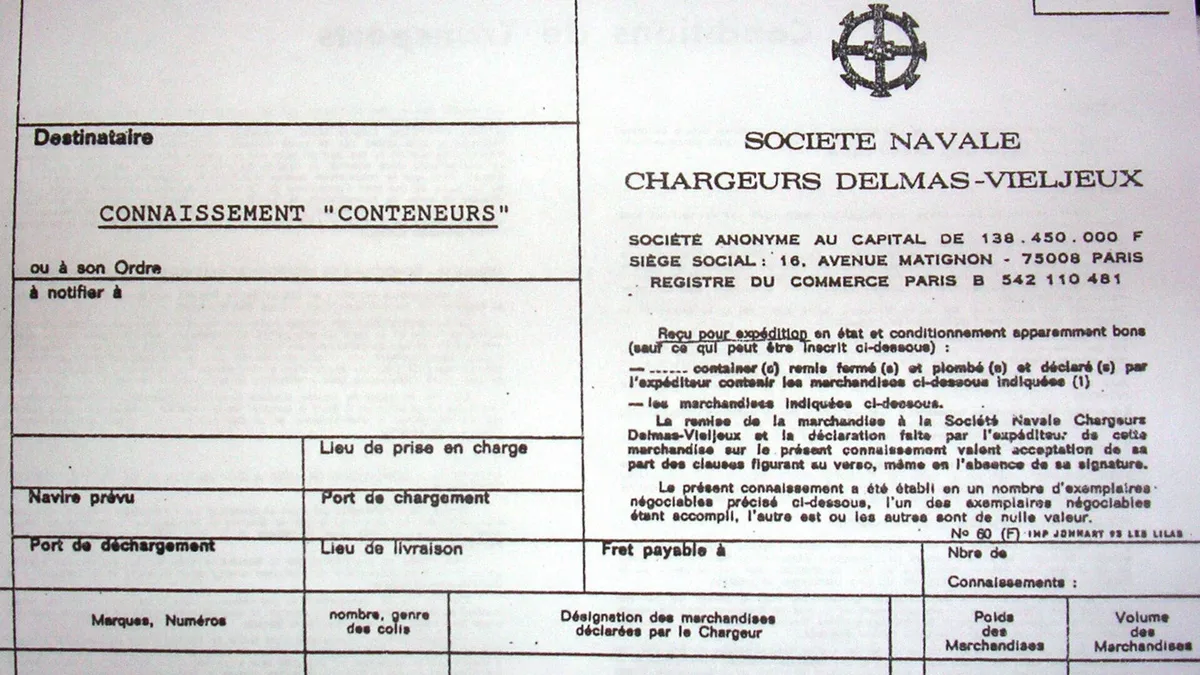
Bills Of Lading, Electronic Bills And Title Transfer
| Tariff line | 4907.00.00 |
|---|---|
| Agreement | WTO Information Technology Agreement (ITA) |
| Country of origin | International agreement |
| First created | 1996 |
| Original use | To eliminate tariffs on specified IT goods |
| Scope | Electronic and paper bills of lading |
| Product coverage | Bound by the ITA's product list and annex |
| Amendment process | By consensus of ITA participants |
Origin and history
The concept of the bill of lading originated in European maritime trade during the medieval period, evolving from earlier shipping receipts. Its legal function as a document of title was formally established in English common law by the 18th century. The electronic bill of lading (eBL) emerged as a concept in the late 20th century with the advent of digital commerce and electronic data interchange (EDI) systems. Early legal frameworks for electronic equivalents, such as the CMI Rules for Electronic Bills of Lading, were introduced in the 1990s. The drive for digitalization intensified in the 21st century due to global supply chain inefficiencies highlighted by events like the COVID-19 pandemic. International bodies like the International Maritime Organization (IMO) and the International Chamber of Commerce (ICC) have since pushed for standardized digital frameworks.
What it is for
A bill of lading serves three primary functions: it is a receipt for goods received by a carrier, evidence of the contract of carriage, and a document of title enabling transfer of ownership. The electronic bill of lading replicates these functions in a digital format to facilitate faster and more secure transactions. This system is designed to eliminate the physical transfer of paper documents, which is a major bottleneck in international shipping and trade finance. It specifically aims to reduce the risk of fraud, loss, and delays associated with couriering paper originals across the globe. In trade finance, it allows for the swift presentation of documents to banks under letters of credit. The title transfer mechanism within an electronic system is crucial for enabling the sale of goods while they are in transit without requiring physical endorsement.
Overview
A bill of lading is a key document in the carriage of goods by sea, though its principles apply to multimodal transport. The paper-based process requires the original, signed document to be physically sent from the shipper to the consignee, often via banks, to claim the goods at the destination port. Electronic bills of lading are facilitated through proprietary digital platforms or registries that control the issuance, transfer, and surrender of the electronic document. Legal recognition of eBLs is achieved through specific contractual frameworks, like the Bolero rulebook, or through national laws adopting models like the UNCITRAL Model Law on Electronic Transferable Records. The system operates on a "surrender" principle where the platform ensures only one party holds the enforceable right to claim the goods at any time. Successful implementation requires all parties in the transaction chain, including carriers, shippers, consignees, and banks, to subscribe to or recognize the chosen electronic platform.
What to know
Not all electronic records are legally recognized as electronic bills of lading; they must reliably perform all three functions of a traditional bill. The legal enforceability of an eBL depends on the governing law of the contract and whether the jurisdiction has enacted supportive legislation. Different electronic platforms exist, such as Bolero, essDOCS, and TradeLens, and they are often not interoperable, locking parties into a single system. A tariff line or shipping service contract must explicitly permit or specify the use of electronic bills of lading for them to be used on a given voyage. The switch from paper to electronic processes requires significant changes to internal workflows, IT systems, and staff training for all involved entities. Banks and insurers must also be willing to accept the electronic document under their specific terms, which has been a gradual process of adoption.
Common questions
What happens if the electronic platform experiences a technical failure or cyber-attack? Reputable platforms have robust contingency and backup procedures, but this remains a perceived risk that parties must assess. How is the signature and endorsement replicated electronically? Platforms use a combination of unique user authentication, private keys, and an immutable audit trail to record each transfer as an "event". Can an electronic bill of lading be converted to paper, and vice versa? Most platforms allow for conversion, but this often nullifies the electronic version to prevent the existence of two originals. Are electronic bills of lading accepted under all Incoterms? They are generally compatible, but terms like CIF and CFR, which involve document sales, are particularly well-suited to the speed of eBLs. What is the cost comparison? While platforms charge fees, they eliminate courier costs, bank discrepancy fees, and demurrage/detention charges caused by document delays. Is global legal recognition uniform? No, despite the UNCITRAL model law, adoption is patchy, requiring careful legal review for trades involving jurisdictions without clear statutes.
Pros and cons
The primary advantage is dramatic speed, reducing document transfer from weeks to minutes, which accelerates trade cycles and releases capital. It significantly reduces the risk of fraud through forged bills and the physical loss of the paper document. Operational efficiencies include lower administrative costs, reduced errors from manual re-keying, and improved visibility of the document's status. The major con is the lack of universal legal acceptance and platform interoperability, creating complexity and risk in global trades. Implementation requires upfront investment and a critical mass of trading partners on the same system, which can be a barrier for smaller entities. A common mistake is assuming all parties in a transaction are ready and legally able to use an eBL, leading to last-minute reverts to paper and confusion. Some entities regret the choice when they encounter rigid partners or banks unwilling to adapt their processes, forcing them to maintain dual systems.
Who it suits
This system best suits large, frequent traders and carriers who move high volumes of containerized goods and for whom document delays cause significant financial cost. It is advantageous for trades involving fast-moving consumer goods or commodities where goods are sold multiple times during transit. Financial institutions actively promoting digital trade finance solutions are strong candidates, as they benefit from reduced processing times and risks. It suits supply chains where all major participants, exporter, importer, carrier, and banks, have the technological capability and contractual willingness to adopt a specific platform. It is less suitable for one-off shipments to or from jurisdictions with uncertain legal recognition of electronic documents. Small and medium-sized enterprises may find the cost and complexity prohibitive unless they are part of a larger digital ecosystem mandated by a dominant partner or industry initiative.